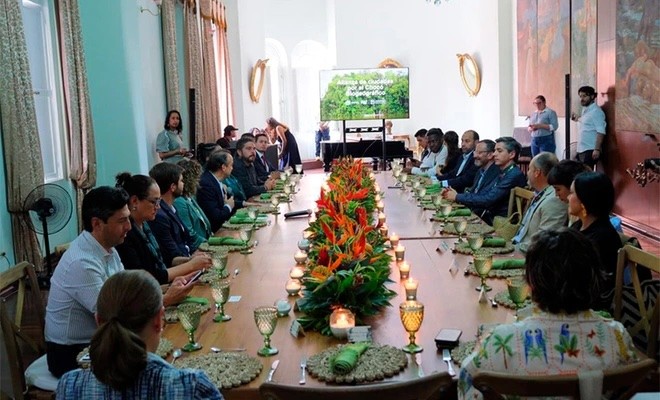
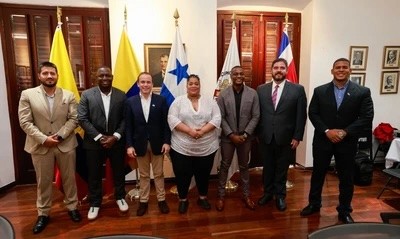
Launch of the Alliance of Cities for the Biogeographic Chocó within the framework of COP16. Cali, 2024. Photo by Silvia Duque and Hannah Leung
ACBC: Alliance of Cities for the Biogeographic Chocó
2024 - Present
NACERA
UMERA
Project Team
Marcela Ángel, Principal Investigator
Angelica Mayolo, Visiting Scholar
Manuela Manzano, Research Associate
Silvia Duque, Research Assistant Fall’24, MCP’25
Hannah Leung, Research Assistant Fall’24, MCP’25
Project Collaborators
City governments of member cities: Limón (Costa Rica); Panama City and Colón (Panama); Cali, Quibdó, Buenaventura and Tumaco (Colombia); and Manta and Guayaquil in (Ecuador).
Organization of American States (OAS)
Pontificia Universidad Javeriana, Bogotá
Other participants: United Nations Environmental Program (UNEP), Development Bank of Latin America and the Caribbean (CAF), Global Initiative Against Transnational Organized Crime (GI-TOC)
Supported By
Inter-American Development Bank (IDB)
Network of nine cities spanning Costa Rica, Panama, Colombia, and Ecuador, working collectively to conserve biodiversity, drive inclusive economic development and social equity, and advance climate change mitigation and adaptation across the Biogeographic Chocó.
Overview
The Biogeographic Chocó (BC) is a strategic mega-ecological corridor for Latin America and the Caribbean due to its high concentration of biological diversity; it encompasses 11,000 recorded plant species (25% of which are endemic) and 1,891 recorded vertebrate species, with 19.8% endemicity. Spanning several countries in the region—notably Colombia, Panama, Ecuador, and Costa Rica, its coastal and ocean ecosystems serve as critical migratory routes for species such as humpback whales and sea turtles, while its tropical forests act as corridors for endemic species such as the golden poison frog and the great green macaw. Nonetheless, despite its vital role in biodiversity preservation and as a global carbon sink due to its vast tropical forests and mangroves, this corridor remains undervalued, underinvested, and under-researched. Currently, it faces compounding crises: illegal mining activity that has increased fourteenfold, contaminating water sources with mercury and heavy metals; illicit crops alongside a 14-fold increase in drug seizures that exacerbate deforestation, violence, and socio-environmental challenges; a migration crisis with over 500,000 migrants crossing the Darién Gap under dangerous and precarious conditions; and unplanned urban growth—driven largely by mining booms, systemic violence, structural inequality, and shifting migration flows—that drives ecological fragmentation and ecosystem degradation around many of its cities.
The Alliance of Cities for the Biogeographic Chocó (ACBC) emerges as a collective effort by nine pivotal cities, including Limón (Costa Rica); Panama City and Colón (Panama); Cali, Quibdó, Buenaventura and Tumaco (Colombia); and Manta and Guayaquil in (Ecuador). The alliance establishes a unified framework to address the overarching threats facing the BC. Specifically, it fosters collaboration in knowledge-generation, the exchange of best practices, and the pooling of resources among member municipalities, while promoting collective action to develop joint projects that amplify regional impact through coordinated efforts.
From Research to Action: The Start of an Alliance within the framework of COP16
The ACBC was launched in October 2024 under the leadership of the City of Cali, within the framework of the UN Biodiversity Conference (COP16) hosted in Cali, Colombia. This milestone event brought together mayors, researchers, and multilateral organizations to discuss the escalating threats to the Biogeographic Chocó and establish cities as key actors in the corridor. NACERA Lab, in its role as the Technical Secretariat of the Alliance, presented critical research findings on the socio-environmental challenges facing the BC, alongside the environmental priorities of ACBC member cities. These priorities span rapid and unplanned urbanization, urban heat islands, flooding vulnerability, illegal mining, habitat loss, and inadequate environmental monitoring systems. The event culminated in the signing of the pact "Cities United for Biodiversity: Coalition Against Illegal Economies Affecting the Environment," marking a commitment to collective action against one of the primary threats to the BC.

MIT ESI and student delegation at COP16. Cali, Colombia, 2024.
Charting the Course: First Mayor’s Assembly in Panama City
The ACBC held its first official meeting in Panama City on April 4, 2025, bringing together mayors and representatives from all nine member cities. Over a day-long workshop, member municipalities approved the Alliance's bylaws and aligned around three core objectives—biodiversity conservation, inclusive development and social equity, and climate change mitigation and adaptation—and established six strategic action lines: (1) strengthening governance and planning capacities to integrate Nature-based Solutions (NbS) into urban development, prioritizing green infrastructure, wetland restoration, and coastal resilience; (2) preventing and monitoring environmental crimes by embedding ecological protection into security agendas and deploying early-warning monitoring systems; (3) fostering transitions toward sustainable value chains, including ecotourism, agroforestry, and food security initiatives that improve community access to training, markets, and financing; (4) promoting education, knowledge-generation, and the integration of scientific, technical, and traditional ecological knowledge; (5) mobilizing multi-stakeholder alliances and financial support by attracting international cooperation resources and partnering with universities, multilateral agencies, private actors, and community organizations; and (6) raising global awareness of the Biogeographic Chocó as a critical ecological corridor by advancing research, engaging in international forums, and driving strategic communications to secure long-term regional support.
To foster institutional synergies, organizations with missions aligned with the ACBC’s strategic vision were invited to present their initiatives. GI-TOC highlighted the systemic links between illegal economies, ecosystem degradation, and community well-being. Meanwhile, CAF presented its BiodiverCities Network and introduced the Fund for the Biogeographic Chocó, underscoring the pressing need to mobilize international investment for regional restoration and community empowerment in the region.


Mayors and representatives of member cities during sessions facilitated by ERA Visiting Scholar Angelica Mayolo and NACERA Lab Director Marcela Angel. Panama City, Panama, 2025. Photos by Panama Citi’s Communications Office and Cali’s Mayor’s Office.
Building Momentum: Engaging New Allies at Cali's Biodiversity Week
The first year of the ACBC’s operations was marked by the third convening of its member cities in September 2025, held within the framework of Cali's inaugural Biodiversity Week. During the meeting, each representative presented local environmental initiatives aligned with the Alliance's strategic priorities. Furthermore, new partnerships were established with the Inter-American Development Bank (IDB) and the Organization of American States (OAS), creating a roadmap for the OAS to co-lead the Technical Secretariat alongside the MIT ERA NACERA Lab.
NACERA, serving as the Technical Secretariat alongside the OAS, UNEP, and Cali's Secretariat of Education, introduced three high-impact project proposals: an integrated coastal bioeconomy initiative designed to enhance water management, local livelihoods, and biodiversity conservation, to be developed in partnership with the OAS, IDB, and MIT; a Nature-based Solutions (NbS) project focused on ecological restoration and community empowerment to promote climate adaptation across the Biogeographic Chocó, in partnership with UNEP; and a Biodiversity Curriculum for schools, emphasizing the Biogeographic Chocó, to be developed alongside the City of Cali and Javeriana University to advance environmental education. Additionally, member cities reaffirmed their commitment to establishing a regional biodiversity governance mechanism, agreeing to undergo a capacity assessment to identify institutional strengths and gaps for scaling NbS in urban areas.


Work session of the Alliance at Cali’s Biodiversity Week. Cali, Colombia, 2025. Photos provided by Cali’s Mayor’s Office.
Related News