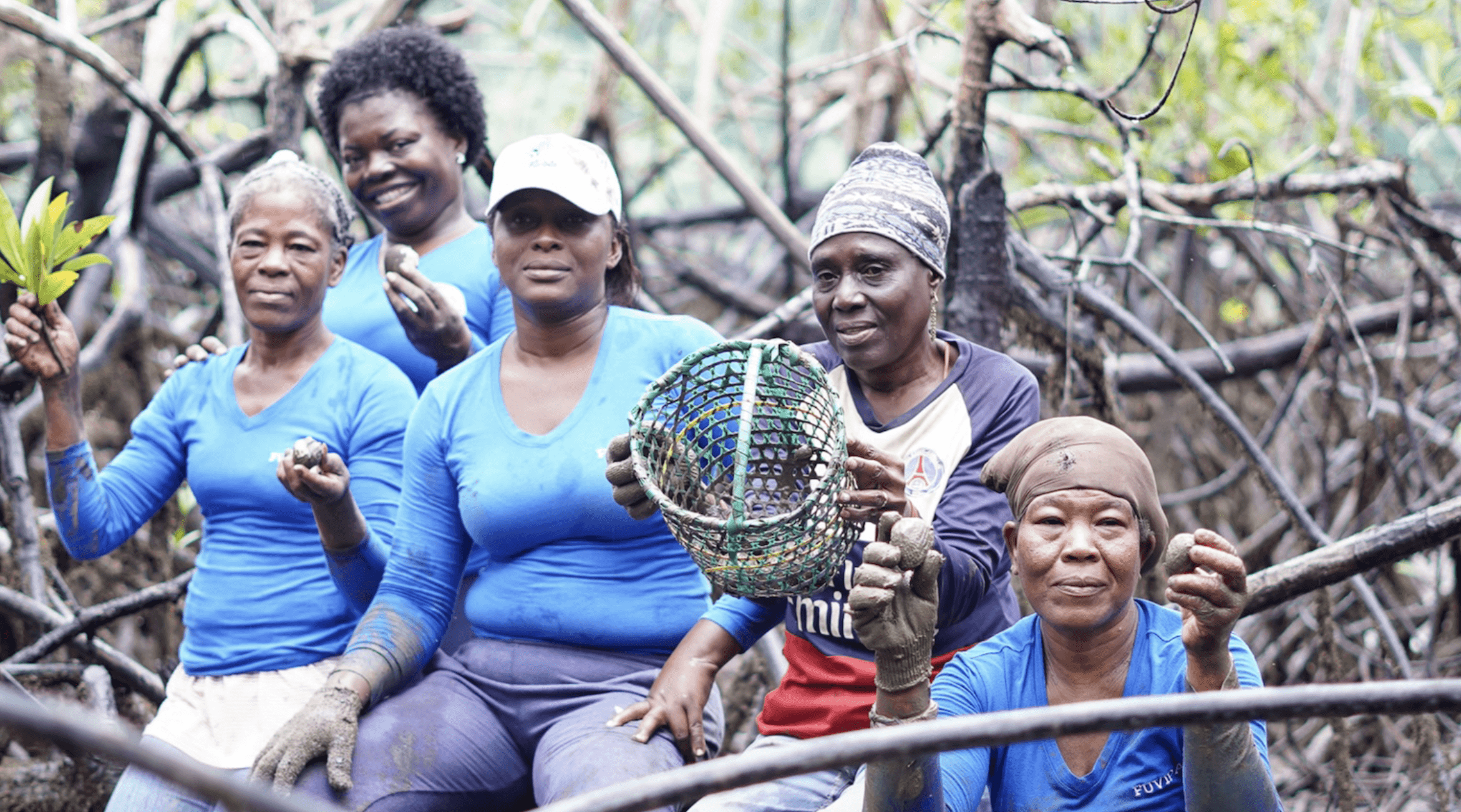
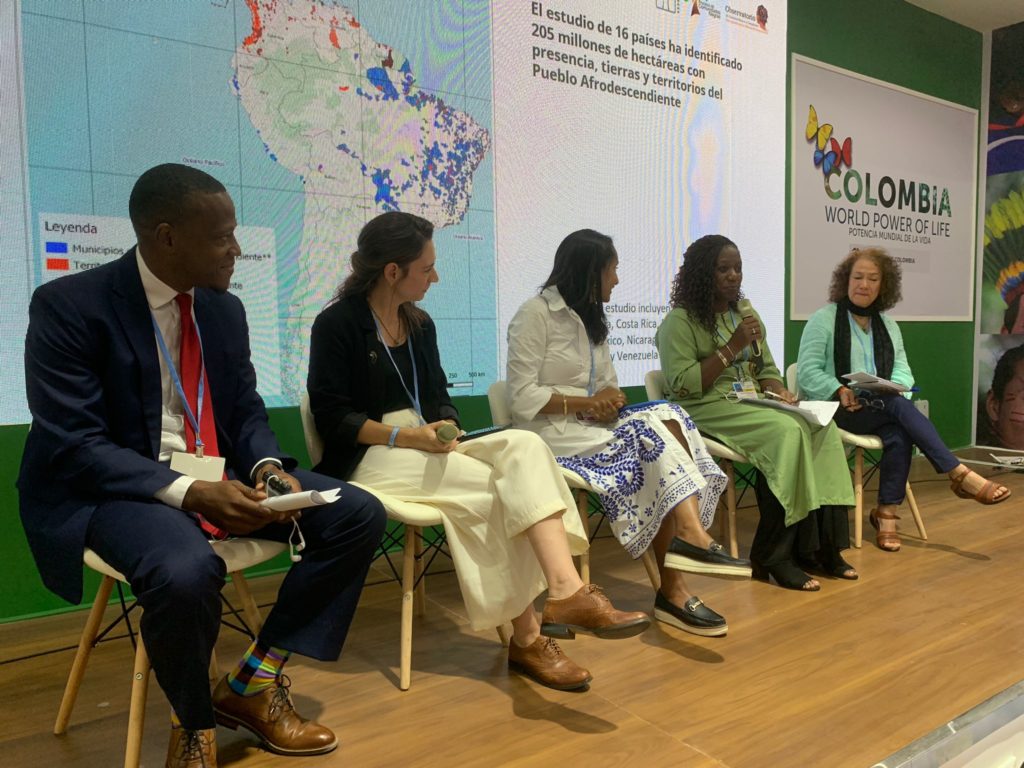
The Invisible Environmental Defenders” side-event at the Colombia Pavilion at COP27. Sharm-Sharm El Sheikh, Egypt, 2022.
AIFCC: Afro-Interamerican Forum on Climate Change
2020 - 2025
NACERA
Project Team
Angelica Mayolo, Visiting Scholar
Marcela Ángel, Principal Investigator
Manuela Manzano, Research Associate
Luis Gilberto Murillo, Visiting Scholar 2020 - 2022
Juan José Mejía, Research Assistant 2022 - 2024
Project Collaborators
Conservation International, US, Kelvin Alie, Marta Rosero
Asociación de Mujeres Afrodescendientes, US, Katy Gil
Comarca Afroecuatoriana, Ecuador, Ines Morales
Desarrollo Sostenible en Centro para la Integración de la Naturaleza y Ciudades (CINC), Panamá, Raisa Banfield
Fundación Mano Cambiada, Colombia, Josefina Klinger
Global Black, US, Amara Enyia, John Tovar
Instituto de Investigaciones Ambientales del Pacifico, Colombia, Zoraida Quesada
Javeriana University, Colombia, Pablo Palacios
ODECO, Honduras, Yimene Calderon, Edwin Alvarez
Red de Formación Ambiental (RFA), Colombia, Heiny Palacios
SUDECC, US, Julio Guity, Robert Asprilla
Supported By
MIT MLK Visiting Scholars Program
Open Society Foundations
Global Americans
CAF Development Bank of Latin America - participation at COP26 and COP27
ACDI VOCA - participation at COP28
The Afro-Interamerican Forum on Climate Change (AIFCC) is a regional platform hosted by MIT ERA that brings together Afro-descendant environmental leaders across the Americas to advance climate action, biodiversity conservation, and environmental justice through research, leadership development, and community-driven solutions that strengthen the agency of Afro-descendant communities as stewards of critical ecosystems.
Afro-descendant communities across the Americas steward some of the world's most biodiverse ecosystems and provide critical environmental services at both local and global levels. Yet, they remain disproportionately vulnerable to the intertwined crises of climate change, biodiversity loss, structural inequality and systemic racism, while frequently being underrepresented in environmental decision-making. In response to these challenges, the Afro-Interamerican Forum on Climate Change (AIFCC) emerged as a regional platform. Co-developed with Colombian former Minister of Foreign Affairs Luis Gilberto Murillo, the AIFCC is hosted by ERA (successor to the MIT Environmental Solutions Initiative). Led by former Colombian Minister of Culture Angélica Mayolo, the AIFCC brings together Afro-descendant community leaders, researchers, and policymakers to identify and address critical research questions, position key debates, and develop leadership skills that reinforce their role as successful guardians of global biodiversity hotspots. .
The Forum pursues three complementary objectives. First, it promotes research to co-create knowledge and raise awareness of the strategic role of Afro-descendant populations in the Americas in advancing Natural Climate Solutions and their contributions to peace, security, and environmental equity. Second, it seeks to increase the participation and visibility of Afro-descendant leaders in climate and environmental governance through leadership development and network building. Third, it supports local engagement and innovation by strengthening capacities and developing a pipeline of community-based projects that foster inclusive and sustainable development across Afro-descendant territories in the Americas.
Mapping Afro-descendant Peoples Lands and their Environmental Contributions
The project built a data-driven framework to document the geographic distribution of Afro-descendant populations across the Americas and visualize and quantify their critical contributions to global climate and biodiversity conservation efforts. We compiled census data, political-administrative boundaries, and environmental geographic datasets across 46 countries and evaluated over 15,500 territorial entities (countries, departments, municipalities, counties, districts, provinces and collective territories) to delineate and characterize Afro-descendant presence across the Americas. Through ecological overlap modeling, we analyzed the correlation between Afrodescendant Peoples’ Lands and global environmental priorities, including global biodiversity hotspots, protected areas, endemic species habitats, carbon-rich ecosystems, and deforestation dynamics.

Spatial overlap between Afro-descendant presence, biodiversity hotspots, and Protected Areas across the Americas at the national and subnational levels 1 and 2. Maps created by Jairton Diez and Marcela Angel.
The spatial analysis revealed a regional demographic footprint of more than 178 million people identifying as Afro-descendant across the Americas. The highest concentrations relative to national populations are clustered within Brazil, Venezuela, Colombia, Ecuador, Suriname, French Guiana, and the Caribbean. This concurrent pattern of high population concentration and spatial isolation within regions of exceptional ecological value represents a direct legacy of historical settlement patterns, whereas maroon communities and self-emancipated peoples established ancestral enclaves in remote, natural resource-rich frontiers to evade colonial systems.
To deepen this framework, ERA researchers and members of the AIFCC supported a pioneering publication titled “Afro-descendant lands in South America contribute to biodiversity conservation and climate change mitigation” led by Conservation International, quantifying the environmental contributions of Afro-descendant Peoples’ officially recognized collective lands across Brazil, Colombia, Ecuador, and Suriname. Utilizing a rigorous statistical matching analysis to isolate the explicit impact of collective land stewardship on environmental preservation, the study revealed that Afro-descendant lands experience 29% to 55% less forest loss than comparable areas, hold three times more threatened species than neighboring areas despite covering just 1% of the study area, and store over 486 million tonnes of irrecoverable carbon.
The magnitude of these findings provides an empirical foundation for quantifying the strategic, yet historically understudied, undervalued, and underfunded role of Afro-descendant communities in global biodiversity conservation and climate mitigation. By rendering these critical territorial intersections visible through data, this research underscores the urgent need to integrate Afro-descendant stewardship into regional policies and global climate frameworks. Ultimately, this evidence reinforces the imperative for their contributions to be systematically supported, capitalized, and integrated into environmental decision-making at every level, guaranteeing their position as central actors in climate and biodiversity action.
Increasing the Participation and Visibility of Afro-descendant Leaders in Global Climate and Biodiversity Governance
Since its inception, the AIFCC has actively engaged in major global forums, including the UN Climate Change Conferences (COP27, COP28, and COP30), the UN Biodiversity Conference (COP16), and key sessions of the United Nations Permanent Forum on People of African Descent (PFPAD). These engagements have served as strategic platforms to identify critical research priorities, present empirical findings that inform policy and grassroots action, and amplify the visibility of Afro-descendant community leaders and innovators advancing Natural Climate Solutions (NCS).
By convening community leaders, academic researchers, policymakers, and international institutions, the AIFCC is actively shaping a more inclusive and equitable global climate and biodiversity governance while positioning Afro-descendant voices as essential stewards of nature. Leveraging a robust network of strategic partnerships, the AIFCC has convened high-level dialogues and side events to advance these priorities, as detailed below:
Launch of the AIFCC at COP26: The AIFCC was officially launched in November 2021 within the framework of the UN Climate Change Conference (COP26) in Glasgow, under the leadership of Colombia’s former Minister of Foreign Affairs, Luis Gilberto Murillo. The inaugural event featured a workshop hosting over 50 Afro-descendant leaders from across the Americas and a keynote panel at the Panama Pavilion, which highlighted Conservation International and the MIT Environmental Solutions Initiative (MIT ESI, precursor to MIT ERA) as founding partners.


Launch of the AIFCC side-events at Panama Pavilion at COP26 and Kelvinside Academy. Glasgow, UK, 2021. Photos by Julio Guity and Kelvinside Academy.
Invisible No Longer at COP27: Building on its regional momentum, the AIFCC hosted a high-level side event at the UN Climate Change Conference (COP27) in Sharm El Sheikh, Egypt, titled “The Invisible Environmental Defenders.” Supported by a broad coalition of prominent institutional partners including the Open Society Foundations, the Government of Colombia, Conservation International, the Rights and Resources Initiative (RRI), and the Development Bank of Latin America and the Caribbean (CAF), the event was held under the leadership of the MIT Environmental Solutions Initiative (precursor to MIT ERA). During the session, ERA co-founder Marcela Angel presented key research findings, while a featured panel showcased project insights from seven Afro-descendant representatives of the AIFCC’s Coordinating Committee. The event facilitated critical dialogues with notable global leaders and policymakers, featuring keynote remarks from David Lammy, then-Shadow Secretary of State for Foreign, Commonwealth and Development Affairs of the United Kingdom; Francisco Canal, then-Deputy Minister of Environmental Planning for Colombia; and Kelvin Alie, Senior Vice President for Field Partnerships in Global Field Programs at Conservation International. Together, these global voices and community leaders highlighted the urgent need for international climate frameworks to recognize, protect, and structurally support Afro-descendant territorial governance and environmental stewardship.


“The Invisible Environmental Defenders” side-event at the Colombia Pavilion at COP27. Sharm-Sharm El Sheikh, Egypt, 2022. Photos by Julio Guity.
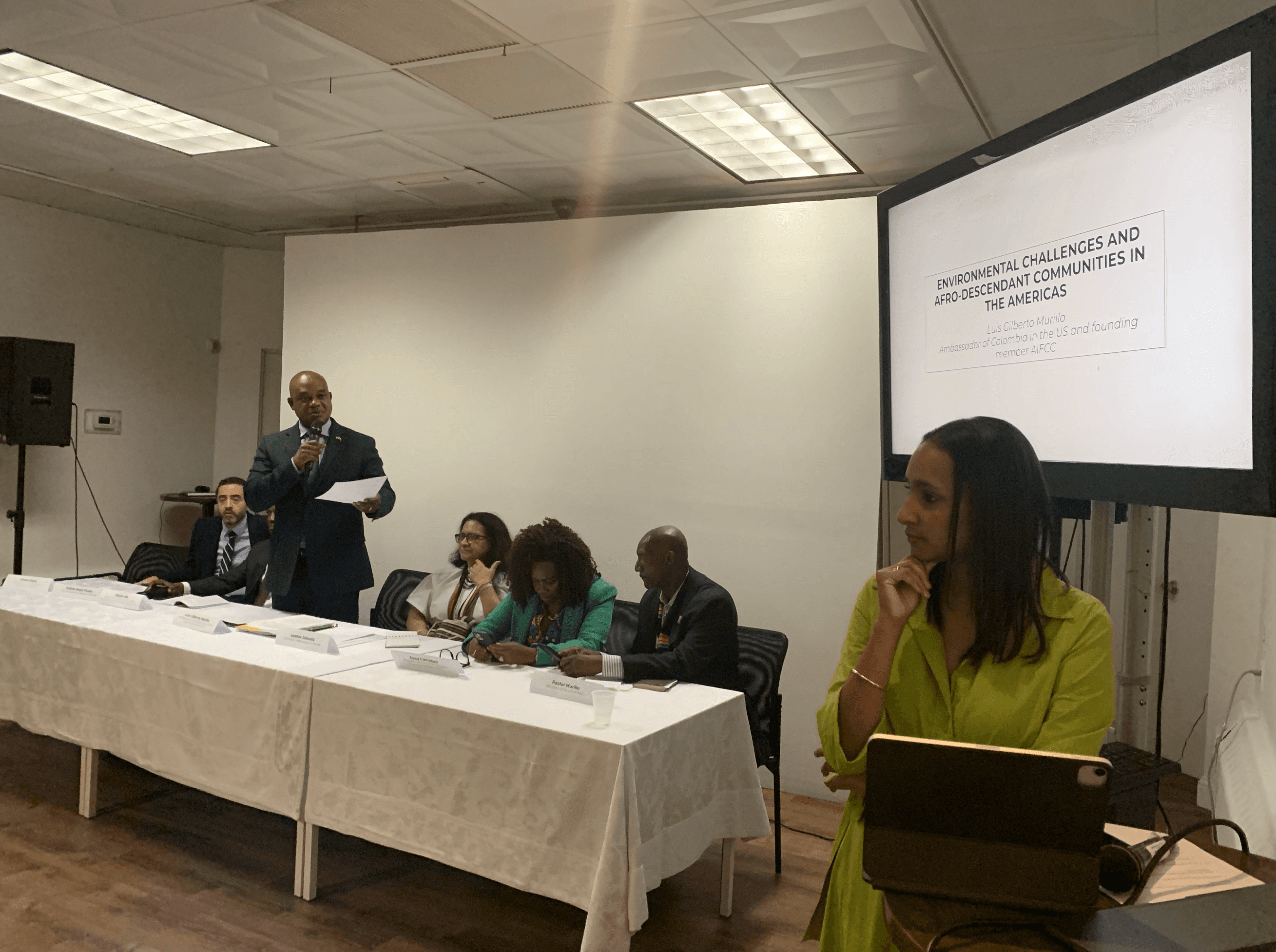
Amplifying the Voices of Afro-Descendant Environmental Defenders at the UN PFPAD: Advancing its regional and scientific diplomacy, the AIFCC hosted a high-level side event at the second session of the United Nations Permanent Forum on People of African Descent (PFPAD) in New York in June 2023. Convened by Colombia’s then-Ambassador Luis Gilberto Murillo, with the participation of former Costa Rican Vice President Epsy Campbell and Pastor Murillo, the primary architect behind the UN Declaration on the Promotion and Protection of the Rights of People of African Descent, the panel, titled “Climate Change and Biodiversity Loss: Challenges and Opportunities for Afro-descendant Communities as Crucial Environmental Defenders,” focused on the acute socio-ecological crises and structural racism confronting Afro-descendant land stewards across the Americas. Organized in close collaboration with Global Black and Conservation International, the session leveraged empirical insights to emphasize the necessity of safeguarding traditional territories, reinforcing the position of these communities as indispensable leaders in global biodiversity preservation and climate resilience architectures.


“Climate Change and Biodiversity Loss: Challenges and Opportunities for Afro-descendant Communities as Crucial Environmental Defenders” side-event at the UN PFPAD. New York, 2023. Photos by Marcela Angel.
Spotlighting the Biogeographic Chocó and the Environmental Contributions of Afro-descendant Peoples' Lands at COP28 and COP30: Advancing its science diplomacy at the UN Climate Change Conference (COP28) in Dubai, Conservation International alongside the AIFCC co-hosted a panel at the Nature Positive Pavilion titled “Research to Action: Insights for Conservation from Afro-Descendant Communities in the Americas”. The session featured the presentation of the landmark study, Afro-descendant Lands in South America Contribute to Biodiversity Conservation and Climate Change Mitigation, by CI’s Martha Rosero. This was followed by a strategic dialogue among researchers, NGO leaders, community representatives, and international cooperation officials from four countries, a milestone that fortified the reach of the AIFCC Researchers Network. AIFCC also convened a side event, "Indigenous and Afro-Colombian Communities' Perspectives for Climate Action and Biodiversity Protection: Integrating Traditional Knowledge, Culture and Local Innovation," highlighting the strategic role of ethnic communities in environmental protection and showcasing community-based climate initiatives. The event underscored Colombia's standing as one of the world's top three megadiverse countries, where Indigenous and Afro-descendant communities steward over 30 million hectares of biodiversity-rich territory, including hotspots such as the Biogeographic Chocó.
Concurrently, COP28 served as a vital platform to elevate the acute conservation crises facing the Biogeographic Chocó: a key strategic ecosystem featuring an exceptionally high concentration of Afro-descendant populations. Convened by MIT ESI (precursor to MIT ERA) and CAF at the Latin America and the Caribbean Pavilion, the side event “The Chocó Biogeographic Region: Urgent Call for a Transnational Effort to Protect Biodiversity” brought together the Climate Change Directors of Colombia and Panama, CAF’s climate leadership, and researchers from Universidad Javeriana and MIT. The panel presented empirical data documenting alarming trends in biodiversity loss across the region, territory where 25% of species are endemic, underscoring that its transnational environmental threats require coordinated international climate action.
At COP30, MIT ERA Visiting Scholar Angélica Mayolo represented the AIFCC at a high-level session hosted by the Inter-American Development Bank (IDB) focusing on Blue Carbon's contributions to marine and coastal ecosystem restoration across Latin America and the Caribbean. The session provided a platform for Mayolo to position the Biogeographic Chocó as a premier destination for blue carbon investment, emphasizing the critical ecological value of the region's coastal and marine ecosystems, while advocating for innovative climate finance mechanisms designed to ensure that Afro-descendant land stewards and local communities serve as direct, equitable beneficiaries of global conservation capital.


AIFCC’s participation at COP28 Side events “The Choco Biogeographic Region: Urgent call for a transnational coalition to protect this biodiversity treasure”, “Indigenous and Afro Colombian communities’ perspectives for climate action and biodiversity protection: integrating traditional knowledge, culture and local innovation” and “Research to action: Insights for conservation from Afro-descendant Communities in the Americas”. Dubai, 2023. Photos by Sabrina Monsalve and Marcela Angel.
Acknowledging linkages between biodiversity and culture at COP16 and the Petronio Alvarez Festival: At the UN Biodiversity Conference (COP16), the AIFCC translated its data-driven research and collective knowledge into a comprehensive set of policy proposals that were presented to the UN during the Afro-Pre-Summit. The recommendations spanned seven strategic priority lines: establishing multilateral financial instruments for conservation and nature-based solutions; scaling scientific knowledge generation on Afro-descendant contributions to biodiversity; ensuring formal Afro-descendant representation within official environmental delegations; creating a transnational task force on collective land titling; designing an inclusive bioeconomy and energy transition strategy; securing direct, transparent access to carbon markets; and fortifying local governance structures through technical training in territorial planning, climate finance, and productive development.
COP16 also provided a platform to spotlight the Biogeographic Chocó as a global conservation priority. At the CAF Pavilion, the side event "Biogeographic Chocó: Delimitation and Transboundary Strategies for Biodiversity Conservation, Climate Action, and Sustainable Development" highlighted the region's ecological significance, the most pressing threats to its biodiversity, and the multi-level actions required to address them. The event underscored that protecting the Chocó demands coordinated multi-level governance strategies alongside recognition of the irreplaceable role that local and Afro-descendant communities play in sustaining biodiversity in the mega ecological corridor.
Broadening its engagement with cultural and traditional knowledge systems, the AIFCC supported the academic agenda of the Petronio Álvarez Pacific Music Festival in Cali, Colombia, in August 2023, one of the largest celebrations of Afro-descendant culture in Latin America. AIFCC members and researchers participated in high-level and technical panels to share empirical insights on environmental protection, emphasizing the indissoluble links between climate resilience, ancestral knowledge, and cultural identity.


AFCC’s Participation at COP16’s Afro-Pre-Summit and the Petronio Álvarez Pacific Music Festival. Cali, Colombia. 2023 and 2024. Photos by Manuela Manzano.
Related Publications
Related News