MIT ARCH+DUSP visit to Isla de la Fantasia within the context of course Biodiversity and Cities: A Perspective in Colombian Cities. Leticia, Colombia, 2023. Photo by Azania Umoja.
ECO-LENS: Mainstreaming Biodiversity Data Through AI
2022 - 2024
SIERA
NACERA
Project Team
Prof. John E. Fernández, PI
Dr. Norhan Bayomi, Co-PI
Marcela Ángel, Co-PI
Enrique Montas, Graduate Research Assistant
Isamar Zhu, Undergraduate Research Assistant
Sean Cheng, Undergraduate Research Assistant
Project Collaborators
Ministry of Environment and Sustainable Development of Colombia (MADS)
Biodiverse and Resilient Cities ProgramInstituto Amazónico de Investigaciones Científicas SINCHI
Leticia Municipality
Corpoamazonia
Indigenous Communities and Community-based organizations, including Maloca de Capiul, Nazareth Community and Junta de Acción Comunal Isla de la Faltasia
Supported By
MIT Climate and Sustainability Consortium (MCSC), Seed Award.
Fieldwork supported by ESI, MISTI, DUSP, MADS and SINCHI.
An AI-driven biodiversity detection and classification framework that combines deep learning, remote sensing, and multi-stakeholder engagement to map urban vegetation and wildlife habitats across cities in biodiversity-rich regions of the Global South.
Overview
ECO-LENS is an AI-based framework developed to automate the identification of urban vegetation from remote sensing data and to characterize neighboring urban-regional wildlife habitats. The workflow is designed to support ecologists, urban planners, and policymakers in producing more precise and efficient urban vegetation assessments, particularly in cities with systemic data gaps. The project responds to the growing need for agile, high-resolution tools to understand urban biodiversity dynamics and their relationship with socio-economic drivers.
Biodiversity Detection and Classification Framework
The backbone of ECO-LENS is a novel Deep Convolutional Neural Network (CNN) architecture organized around three cascading tasks. Task 1 performs binary classification of urban vegetation presence from aerial imagery. Task 2 uses LiDAR data collected via UAVs to identify individual tree canopies and generate Tree Canopy Height (TCH) profiles through Multiscale Analysis and Segmentation (MSAS). Task 3 classifies tree types and maps them to associated wildlife habitats, producing an urban biodiversity profile that connects vegetation cover to ecological services.
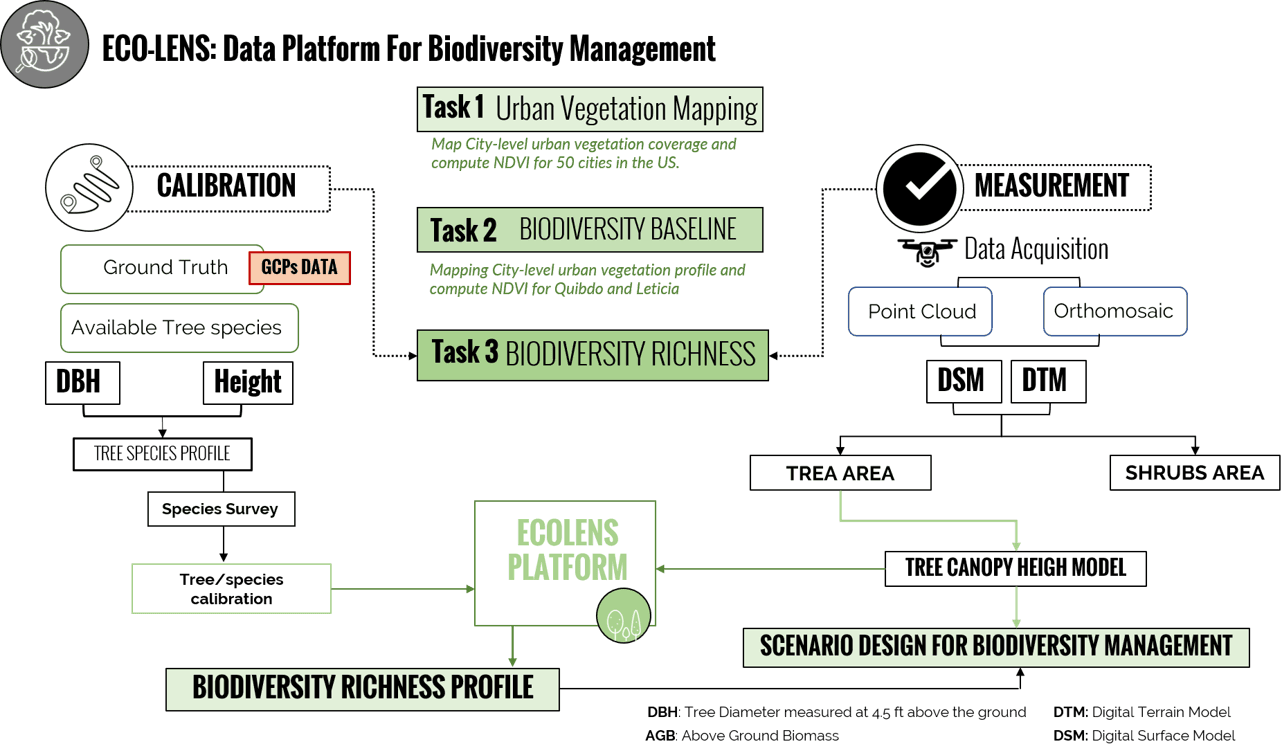
ECO-LENS framework, 2022. Diagram by Norhan Bayomi.
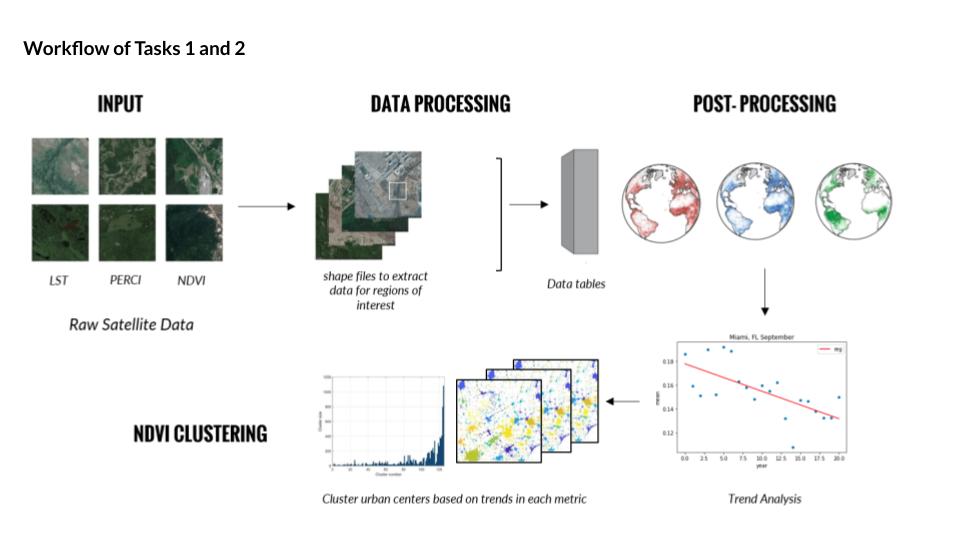
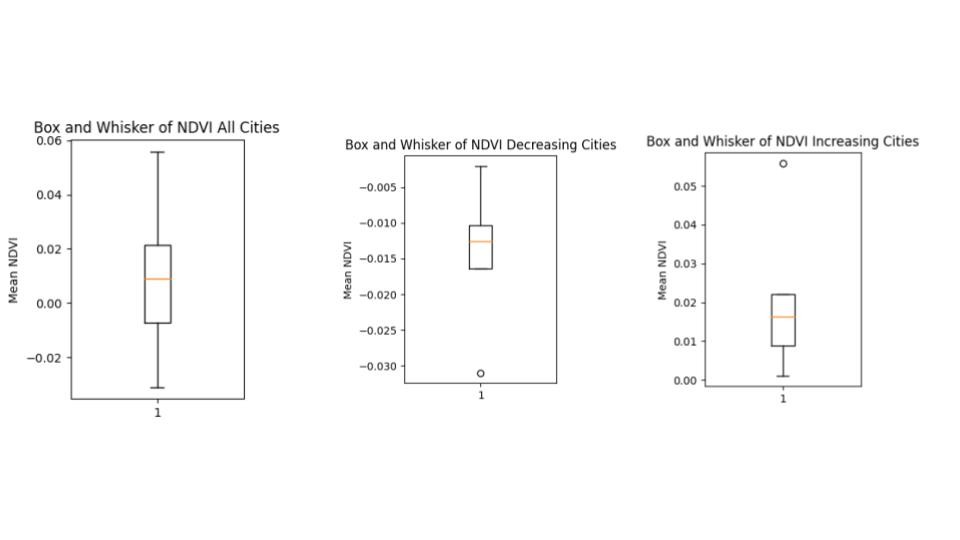


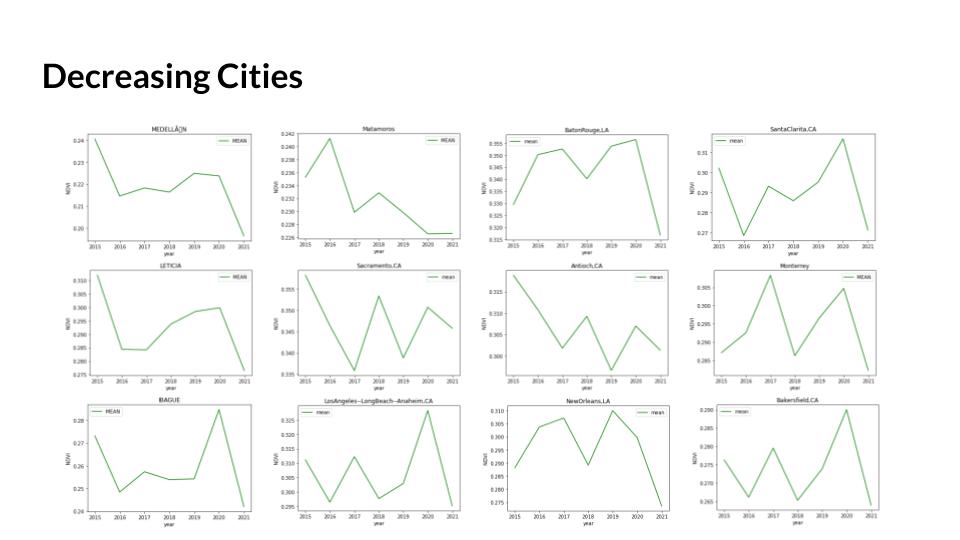
ECO-LENS NDVI clustering, 2023. Diagrams by Enrique Montas.

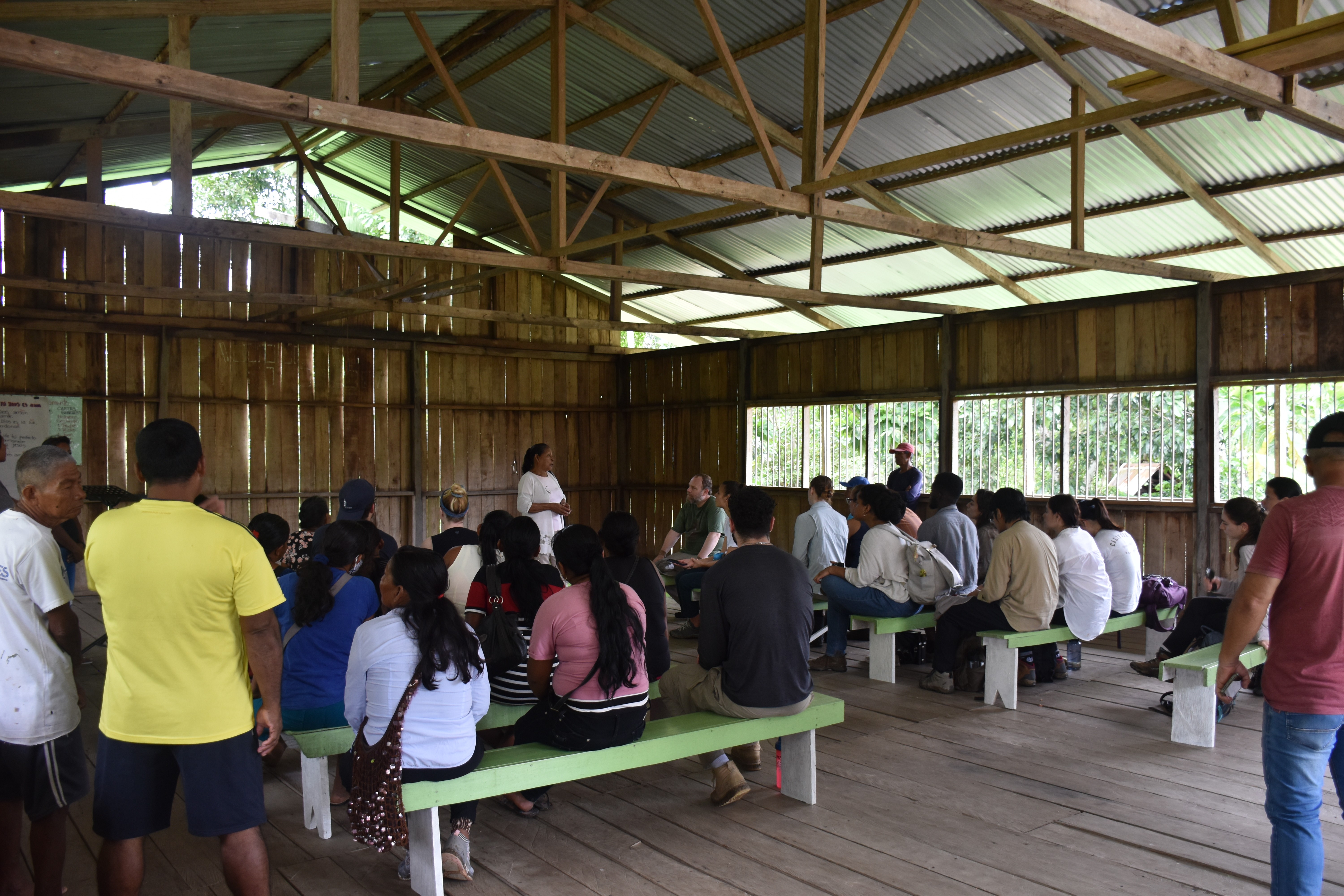
Community meetings in Nazareth and Isla de la Fantasia communities, within the context of course Biodiversity and Cities: A Perspective in Colombian Cities, 2023. Photos by Marcela Angel and Lauren C. Moore.
The project integrates multiple data sources at different spatial scales. Sentinel-2 multispectral imagery provides city-level vegetation mapping across approximately 9,000 cities globally. High-resolution LiDAR data enables detailed canopy delineation for 50 representative US cities and a pilot deployment in Leticia, Colombia.
Leticia Case Study and Multi-stakeholder Engagement
ECO-LENS uses the Colombian city of Leticia, located in biodiversity-rich and carbon-dense ecosystems in the Amazon region, as a case study. This city faces disproportionate climate change impacts compounded by structural inequalities and limited access to adaptation resources. Its population has a strong presence of indigenous communities. The engagement component featured a one-week immersion involving meetings and interviews with various stakeholders, including local institutions, government agencies, community-based organizations, and research partners. This provided an in-depth understanding of local priorities and diverse perspectives, ultimately aiming to strengthen community participation and citizen science in biodiversity management.This component is designed to ground the technical outputs in local planning contexts and facilitate the adoption of ECO-LENS data by policymakers for biodiversity management, climate planning, and nature-positive urban development strategies.