“Equitable Markets: Lessons learned on the participation of Ethnic Communities in Colombia’s Voluntary Carbon Market and its implication for Biodiversity Credits” side-event at CAF Pavilion, COP16. Cali, Colombia, 2024. Photo by Juan José Mejia.
Equitable Carbon Markets: Addressing Equity and Governance Deficits in Colombia's Voluntary Carbon Market
2023 - 2026
NACERA
Project Team
Marcela Ángel, Principal Investigator
Angelica Mayolo, Visiting Scholar
Martin Perez Lara, Research Affiliate (WWF)
Jimena Muzio, Researcher Associate
Diego Casas, GIS Specialist
Juan José Mejia, Research Assistant
Project Collaborators
WWF US
Supported By
MIT MLK Visiting Scholars Program
Asocarbono, Data Sharing
CAF Development Bank of Latin America, Side-event host at COP16
Afro-Interamerican Forum on Climate Change (AIFCC), outreach and consultations
Databases
Analytical assessment of Indigenous Peoples, Afro-descendant and Local Communities’ (IPALC) role in Carbon Forestry Projects and the expansion of the Voluntary Carbon Market in Colombia. Integrating qualitative research, regulatory and spatial analyses, and a novel theoretical framework, the study provides evidence and actionable policy recommendations to enhance community participation and equity in conservation finance mechanisms.
Overview
Voluntary Carbon Markets (VCMs) have expanded rapidly in Colombia, where Carbon Forestry Projects (CFPs) now cover more than 26 million hectares, with 92% overlapping Indigenous Peoples, Afro-descendant, and Local Communities (IPALC) territories. While CFPs projects provide significant conservation finance and opportunities for sustainable development, concerns regarding governance, participation, transparency, and equitable benefit-sharing compromise their long-term integrity,social legitimacy and the potential for durable, community-driven conservation outcomes..
Conducted between September 2023 and August 2024, this study combines spatial analysis and qualitative methods to examine the conditions necessary for effective and equitable community-based conservation in Colombia’s VCM. The study pursues three objectives: (1) to provide a comprehensive overview of the market share and map the geographic distribution of CFPs and their overlap with IPALC territories, strategic ecosystems, and reported conflicts in IPALC’s territories; (2) identify the main governance and institutional barriers faced by IPALC that hinder their effective participation in CFP encompassing an assessment of the regulatory landscape, governance mechanisms, existing safeguards, progress made towards equitable benefit-sharing, and project’s contribution towards the Sustainable Development Goals (SDGs); and (3) develop a framework to assess and strengthen equity dimensions in VCMs and apply it to the case of Colombia’s VCM.
Spatial Analysis of Carbon Forestry Projects and Collective Community Territories in Colombia
Our study developed Colombia's first publicly available CFP geodatabase, consolidating information from 218 projects and generating a series of spatial indicators and maps to assess overlaps with Indigenous Peoples, Afro-descendant and Local Communities (IPALC) territories, strategic ecosystems, and CFPs with reported conflicts. This analysis provides a comprehensive overview of the scale and territorial footprint of Colombia’s Voluntary Carbon Market (VCM).


Figure 1 depicts CFP and Nationally Protected Areas (PA) in Colombia; figure 2 shows the overlap between CFP and IPALC territories; and figure 3 overlays carbon forestry projects with reported conflicts in IPALC territories. (Angel et al., 2025).
Key Findings
CFP have expanded to nearly 26 million hectares, covering 22.7% of Colombia’’s continental area, and surpassing the 19.5 million hectares protected under the National System of Protected Areas.
Reducing emissions from Deforestation and Forest Degradation projects (REDD+) projects, account for 98.4% of total CFP’s areas while Afforestation/Reforestation (ARR) remains limited.
92% of REDD+ project areas overlap IPALC lands, encompassing 60% of Indigenous Reserves, 71% of Afro-descendant Community Council territories, and 0.5% of Peasant Reserves, involving 71 Indigenous communities, 35 Afro-descendant community councils, and 7 Peasant Reserves (No ARR projects are identified within IPALC’s territories.)
CFP cover 21 million hectares of forest, accounting for 37% of Colombia’s total forested area in 2022.
There is an overlap of 1.6 million hectares between REDD+ projects and Nationally Protected Areas.
59% of the 218 projects have already issued credits, generating nearly 160 million carbon credits and mobilizing approximately USD 180 million.
The market is highly concentrated in the Amazon and Pacific regions, where projects cover 44.5% and 34.6% of these territories, respectively.
37 projects with reported conflicts were identified, affecting 37.5% of the total project areas. Most conflicts are co-located in Indigenous territories (21 cases), followed by Afro-descendant territories (8), peasant reserves (2), and unidentified communities (5).
Key Messages
The VCM has surpassed protected areas in scale, but its rapid and decentralized growth has produced uneven outcomes and exposed important governance gaps.
Carbon finance, with annual project revenues ranging from USD 867,000 to USD 16.7 million over 20–30 years, is reaching remote areas in the Amazon and Pacific, representing an unprecedented source of conservation finance to target frontier areas facing emergent pressures with revenue sources to strengthen communal governance, monitoring systems, and livelihood options that shift the business-as-usual trajectory. While reported community rights conflicts are present in a relatively small number of projects, likely reflecting underreporting, they account for large expanses of land. These conflicts most commonly stem from disputes regarding land tenure, benefit-sharing arrangements, intermediary conflicts of interest, and the legitimacy of decision-making processes. This highlights the critical importance of strengthening governance mechanisms, ensuring equitable benefit-sharing, and fostering meaningful community participation to secure the long-term sustainability of the market.
Given that CFPs operate across diverse regions with differing deforestation rates, diverse socio-cultural contexts, and varying levels of territorial governance capacities, a surge in market demand could rapidly push VCM initiatives into the remaining of IPALC’s territories
Overlapping CFPs with Protected Areas raises concerns regarding double counting and additionality. However, the additionality of REDD+ initiatives within these territories must be evaluated against intensifying deforestation risks and weak institutional contexts. Although legal status technically bans clearing, protection mechanisms frequently fail when undermined by weak institutional capacity and high market pressures. Under these conditions, Protected Areas, IPALC collective land rights, and CFP economic incentives must be treated as complementary, interlocking strategies rather than mutually exclusive choices as their efficacy relies on their combined deployment to target different dimensions of deforestation pressures
To maintain high environmental integrity, Colombia's CFPs must shift away from low-risk deforestation locations. Carbon finance should be systematically funneled into high-pressure frontier areas, whether within collective territories or PAs, where the threat of deforestation is demonstrably high, baselines are conservatively formulated, and carbon projects revenue can bridge critical gaps in local enforcement, co-management, natural resources management and ecological restoration.
Governance, Equity and the IPALC Participation Ladder
Our study conducted a qualitative assessment of the enabling and disabling factors shaping participation across Colombia’s VCM. The analysis combined semi-structured interviews, transcript coding, and thematic analysis covering the regulatory landscape, governance and participation mechanisms, benefit-sharing arrangements, existing safeguards, and the contribution of CFP to the SDGs.
A central contribution of this study is the “IPALC Participation Ladder”, an eight-level framework mapping the progressive engagement of communities within the VCM. The lowest rungs of this continuum reflect acute existing challenges, where communities experience fraud, manipulation, or a lack of structural support to participate effectively. Communities ascend the ladder as their agency expands: they progressively overcome participation barriers and develop the self-organizing capacity needed to leverage CFP financial opportunities. At the highest tiers, engagement in CFP actively strengthens community governance and norms, culminating in complete autonomy over project design, implementation, and benefit-sharing.
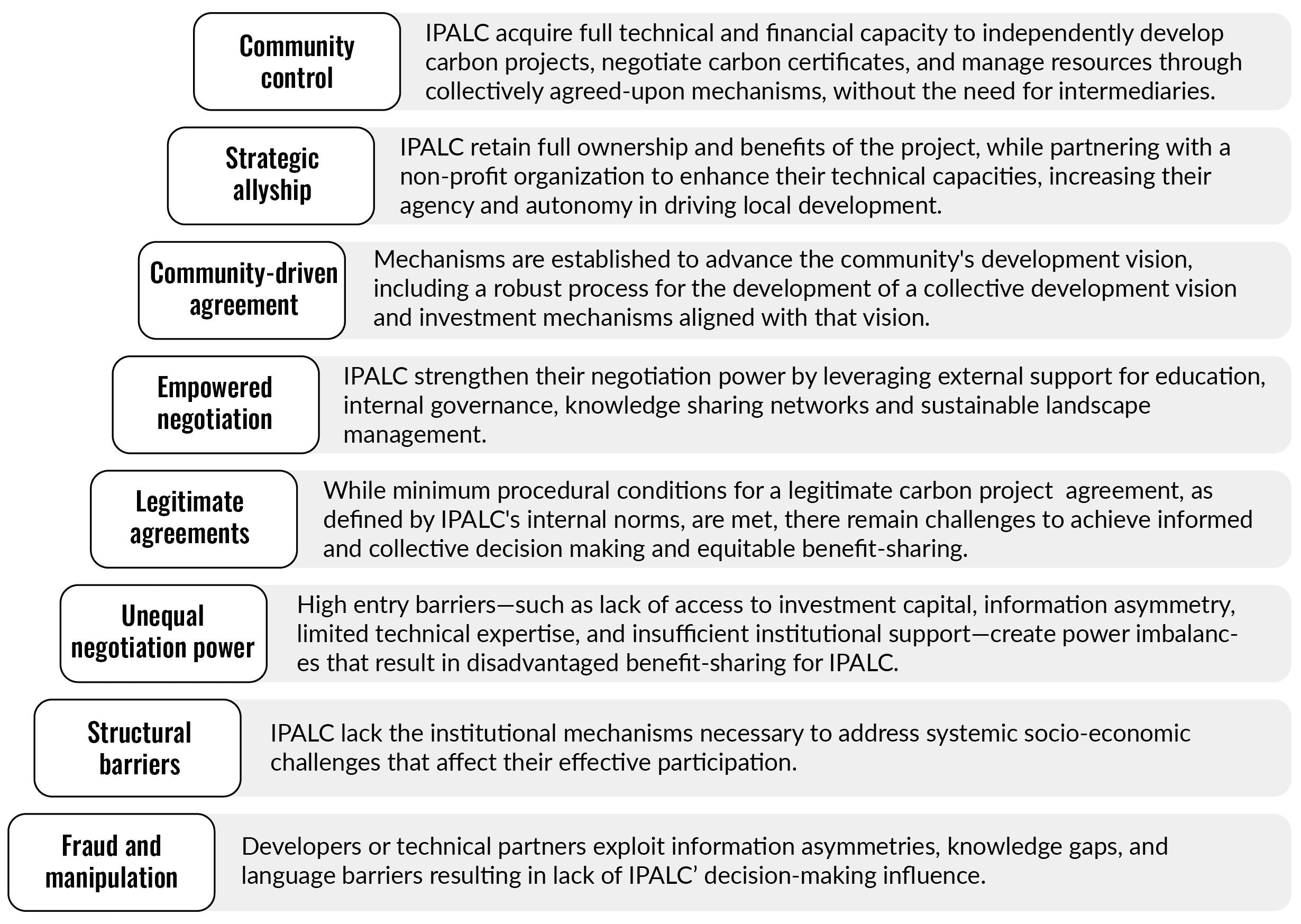
IPALC Participation Ladder for VCMs: theoretical framework that includes a range of eight levels of engagement and associated conditions or participation mechanisms (Angel et al., 2025).
Key findings
Applying the framework to Colombia’s VCM reveals that, while experiences vary significantly, current market dynamics, incentive structures, and policy gaps tend to favor projects that remain at intermediate levels of participation, suggesting a systemic issue and structural barriers of participation and a mid-ladder trap.
Prevalence of experiences in the lower levels demonstrate that existing safeguards have proven insufficient to prevent manipulation and conflicts at the lowest levels, while a couple of cases of high-participation models demonstrate that more equitable alternatives to intermediary and profit-driven approaches are feasible.
Meaningful participation depends on governance capacities as well as material conditions such as land extent, quality and natural resources, and social development indicators, including secure land rights and tenure, strong local institutions, and forest management capacities.
Although community control represents the highest level of the participation ladder, it remains largely theoretical and may not always be optimal at the individual community level. Operating in isolation can prevent communities from leveraging economies of scale and pooling collective knowledge. Conversely, community associations are uniquely situated to aggregate, analyze, and disseminate the experiential and shared knowledge necessary to strengthen systemic community control.
Key Messages
Stronger local institutions and governance capacities are associated with higher levels of participation and more equitable outcomes. While CFP have expanded conservation finance to underserved regions, the long-term effectiveness of community-driven conservation efforts depends on progressively shifting ownership, decision-making authority, and benefit-sharing toward IPALC, transforming communities from beneficiaries into architects of climate and development strategies.
High-participation models demonstrate that VCMs can support community-led conservation, sustainable livelihoods, and durable climate outcomes when investments are aligned with local priorities and communities retain meaningful control over resources and development decisions. Crucially, both our data and emerging literature indicate that the organizational structure of developers matters: impact-oriented non-profits effectively reduce entry barriers by funding extensive community preparation processes that actively strengthen internal governance, local technical capacity, and financial literacy.
A heavy concentration of projects remains trapped in "mid-level" participation, characterized by procedurally "legitimate" agreements, fail to provide consistent, long-term empowerment. This pattern is driven by a proliferation of intermediaries (developers, aggregators, multiple standards, and VVBs), persistent information asymmetries. Under a weak institutional context, these dynamics significantly elevate the risk of external value capture and unequal benefit distribution.
The mid-ladder trap highlights the urgent need to formalize intermediary roles and establish robust, cross-scale institutions capable of negotiating among stakeholders, enforcing rights, promoting transparency, and managing conflicts. Ultimately, market integrity requires stronger public oversight and accountability, standardized minimum terms for benefit-sharing, and accessible grievance mechanisms.


“Equitable Markets: Lessons learned on the participation of Ethnic Communities in Colombia’s Voluntary Carbon Market and its implication for Biodiversity Credits” side-event at CAF Pavilion, COP16, including presentations by co-authors and the participation of actors across the VCM ecosystem: Asocarbono, CAF Development Bank of Latin America, and Fondo Acción. Cali, Colombia, 2024. Photos by Juan Jose Mejia.
Policy and Action Recommendations Across the Carbon Market Ecosystem
This research led to targeted recommendations for each key actor in Colombia's voluntary carbon market ecosystem and outreach activities within the framework of the Global Biodiversity Conference COP16. Indigenous, Afro-descendant, and local communities are advised to leverage projects to strengthen internal governance and technical capacities to participate in negotiations, encourage community associations to define minimum benefit-sharing standards, and establish accountability mechanisms such as community assemblies for revenue management. Governments are called to create regulatory frameworks, oversight bodies, and unified information systems that ensure transparency and protect community rights. Developers are urged to implement stronger contractual safeguards, promote the creation of community oversight mechanisms, and adopt culturally appropriate engagement practices. Verification and Validation Bodies must move beyond document review toward genuine participatory verification, while Standards and Registries should require greater financial traceability, social impact measurement, and public access to information on benefit-sharing agreements. Together, these recommendations offer a roadmap for transforming Colombia's carbon market into a more just, transparent, and community-centered system.
Related News