City of Cali, Colombia, 2025. Photo by Carlos Vera.
NbS Chocó: Biodiversity Management Governance Mechanisms Through Nature-Based Solution implementation (NBS) in the Biogeographic Chocó of Colombia
2025 - Present
NACERA
Project Team
Marcela Ángel, Principal Investigator
Angelica Mayolo, Visiting Scholar
Manuela Manzano, Project Manager
Jaime Asprilla, Executive Director (Amunafro)
Andrea Gomez, Policy Analyst and Engagement Coordinator (Amunafro)
Estefania Sanabria, Research Assistant (Amunafro)
Project Collaborators
The National Association of Mayors and Governors of Municipalities and Departments with Afro-descendant Populations (AMUNAFRO)
City governments of Cali, Buenaventura, and Quibdó
Governments of Valle del Cauca and Chocó
Regional Environmental Authorities (CVC and CODECHOCÓ)
Research Institutes IIAP and the Humboldt Institute
Ministry of Environment and Sustainable Development (MADS)
Alliance of Cities for the Biogeographic Chocó Region
Supported By
Inter-American Development Bank (IDB)
A multi-stakeholder governance model focused on advancing Nature-based Solutions (NbS) across three cities in the Colombian Biogeographic Chocó Ecological Corridor that combines comprehensive policy assessments, capacity building for public officials, and participatory platforms for community-driven action to develop a pipeline of NbS.
Overview
The Biogeographic Chocó (BC) is one of the world's most critical biodiversity hotspots. It hosts over 25% of the globe’s endemic species and contains vital ecosystems that drive carbon sequestration and support over 20% of local employment. Despite this ecological wealth, cities within the BC face compounding challenges when asserting themselves as conservation leaders, including historical marginalization, socio-economic vulnerability, unplanned urban growth, and mounting climate pressures. By aligning public policy, capacity building, stakeholder engagement, and targeted investment pathways toward Nature-based Solutions (NbS), these cities can protect regional biodiversity, mitigate climate risks, and empower local communities as co-designers of their bio-cultural assets and sustainable future.
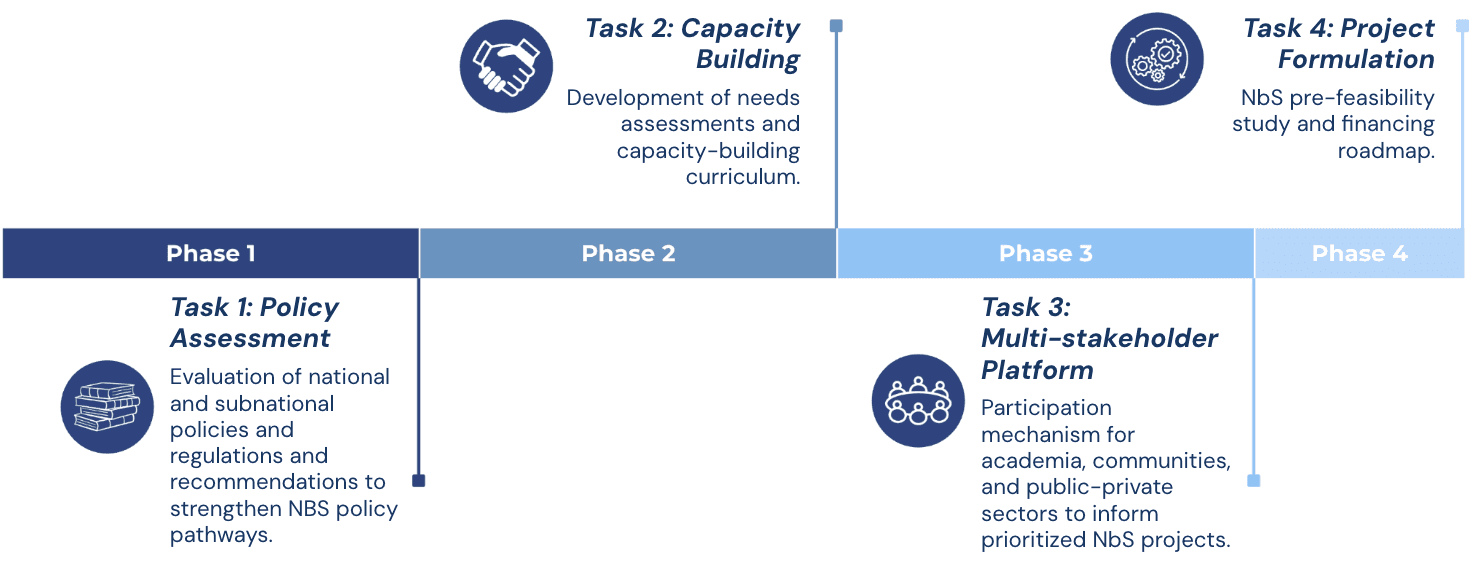
To drive this transition, the NBS Chocó project supports the Colombian cities of Cali, Buenaventura, and Quibdó in their ecosystem protection efforts. The project develops a multi-stakeholder governance model focused on advancing NbS through four strategic objectives: strengthening gender-responsive policy frameworks, building local capacities for the implementation of NbS-enabling regulations, establishing multi-stakeholder platforms for participatory NbS identification and prioritization, and supporting the development of policy and project proposals across all three target cities.
Strengthening NbS Policy Pathways
The first phase of the project addresses policy gaps hindering NbS adoption and identifies opportunities to strengthen frameworks, with a specific focus on gender and inclusion. This task is grounded in a rigorous analysis of 45 national and regional regulatory and policy instruments, alongside interviews with 11 policymakers, former government officials, experts, and community leaders. The assessment examined the intersection of six thematic areas (water management, biodiversity, green infrastructure, nature-based economies, energy and decarbonization, and coastal ecosystems) against five enabling dimensions: governance and institutional capacities, financing, inclusion, incentives, and co-benefits.
Within the current policy landscape, Colombia’s newly enacted Green Cities Law 2476 of 2025 serves as a key enabler by mandating ecological infrastructure and monitoring obligations that support NbS scaling in urban areas. Therefore, a core component of this phase was a readiness assessment to evaluate local capacities to comply with the competencies and obligations established by this law. This analysis identified critical gaps in financing access, institutional capacity, and local operational alignment across the target municipalities. Specifically, it highlighted the stark contrast between a large-scale city like Cali—an economic hub with recognized international leadership in biodiversity conservation—and small-to-medium-sized cities like Quibdó and Buenaventura, which face historical marginalization and critical unsatisfied basic needs.
To address these gaps, the project's recommendations center on four strategic priorities: strengthening governance through a national NbS project portfolio; unlocking dedicated financing mechanisms and tax incentives, including embedding NbS criteria into public investment systems to drive implementation at scale; fostering inclusive partnerships across public, private, and community sectors; and enhancing decision-support tools to guide local action.

Summary of readiness analysis to implement Colombia’s 2025 Green Cities Law.
Developing Local Capacities for NbS Implementation
The second phase of the project focuses on identifying capacity-building priorities across the three cities and delivering a tailored training curriculum for public officials that aligns with each city's unique territorial, institutional, and socio-environmental contexts. To achieve this, the project first conducted a needs assessment to identify existing assets, knowledge gaps, and capacity constraints hindering NbS implementation. Second, it established a localized Task Force for each city based on an analysis of institutional architectures, mapping key decision-makers and NbS-enabling functions. Finally, the project designed and implemented six training modules anchored in four pedagogical principles: problem-based learning addressing real urban challenges, peer-to-peer knowledge co-construction, an intercultural and ethnic-territorial approach, and experiential learning with immediate institutional applicability.
The training curriculum addressed both cross-cutting themes and city-specific priorities. The cross-cutting modules focused on biodiversity monitoring to support compliance with the Green Cities Law and gender-responsive indicator design for NbS. The city-specific modules targeted localized needs: integrating Sustainable Urban Drainage Systems (SUDS) into planning instruments in Cali; advancing mangrove restoration and strengthening private sector engagement in Buenaventura through a public-private green space adoption model; and implementing Payment for Ecosystem Services (PES) in Quibdó.
At the conclusion of the workshops, a distinct policy pathway was identified for each city, resulting in three concrete goals:
Cali: Developing a comprehensive recommendations document to integrate Sustainable Urban Drainage Systems (SUDS) into the city's Land Use Plan.
Buenaventura: Drafting a forestry policy agreement to serve as a public policy instrument enabling green space adoption, urban forestry, and NbS implementation under a clear, coordinated framework.
Quibdó: Creating an operational manual for Payments for Ecosystem Services (PES), including a set of agreed-upon indicators to support the design, implementation, and evaluation of local PES schemes.

Needs assessment workshops. Cali, Quibdó and Buenaventura, February 2026. Photos by Manuela Manzano and Andrea Gómez.
Multi-Stakeholder Platforms for NbS Project Prioritization and Planning
The workshops successfully identified five potential projects for implementation across the three target cities. In Cali, proposed initiatives include a regional environmental monitoring center to strengthen data collection and analysis, alongside the design of a pilot Sustainable Urban Drainage Systems (SUDS) project that brings together public institutions, private sector actors, and local communities. In Buenaventura, the focus is on a pilot program for private sector actors to adopt and manage public green spaces in partnership with community action boards to ensure inclusive, sustainable implementation, as well as a mangrove restoration project linking ecosystem recovery with community participation. Finally, in Quibdó, the project entails the design of a Payment for Ecosystem Services (PES) pilot project focused on the collective lands of Afro-descendant communities adjacent to the city.


Capacity-building workshops. Cali, Quibdó and Buenaventura, April 2026. Photos by Carlos Vera and Manuela Manzano.
The final phases of the project aim to establish three thematic, multi-stakeholder platforms to advance the prioritized NbS projects. These platforms will facilitate the mapping and identification of community-based initiatives aligned with selected NbS typologies, identify public and private financing mechanisms, and engage academic partners. Ultimately, these collaborative efforts will enable the target cities to build a pipeline of technically viable, financially sound, and socially inclusive NbS projects capable of attracting long-term investment.
Related Publications